
Part 2
Anti-trafficking Awareness Campaigns
In our Part 1 Resource, we explored whether anti-trafficking awareness campaigns achieve their intended impact. Let’s explore further, and discuss how we can do better.
Are Awareness Campaigns Preventing Trafficking In Canada?
In short, there is no evidence to suggest that they are.
Current research does not show a clear link between awareness campaigns and trafficking prevention, though there is evidence that such campaigns limit people’s engagement in meaningful anti-trafficking work.
Because these campaigns are presented to the public as the solution to trafficking, most people do not engage beyond sharing a post, wearing a lapel pin, or joining a walk-a-thon. People’s understanding of the issue remains shallow and narrow, and underlying risk factors—poverty, lack of labour protections, racism, etc.—are not meaningfully addressed, if mentioned at all.
Across industries like hotel, transport, and food service, awareness campaigns promote suspicion of increasingly regular aspects of daily life—dining alone and ordering takeout have been added to the list of trafficking indicators—and call for specialized training to enhance awareness of human trafficking.
Because these ‘red flag’ indicators can apply to so many people and situations, they lose their usefulness in identifying trafficking.
As more and more issues are casually labelled ‘human trafficking’, the term will, over time, have no meaning at all. Awareness campaigns can become repetitive or symbolic responses that create a sense of action.
Ultimately, the awareness does not prevent trafficking or provide meaningful support to victims or survivors.
So, who are these campaigns really for?
Are they for victims and survivors of trafficking?
Increasingly, victims and survivors say they do not recognize themselves in the red flag indicators.
Are they for the donating public to ‘do something’ about human trafficking?
They have been successful in generating funding and public engagement, but the actual results for victims and survivors are limited.
Or are they for large anti-trafficking organizations that focus on broad awareness?
Unfortunately, these campaigns bypass the more complex root causes that put people at risk in the first place.
Repeated, oversimplified awareness messaging waters down public understanding, making trafficking easier to talk about publicly while leaving out the harder conversations about the systems and conditions connected to exploitation. Some training modules take only 3-5 minutes to complete!
But if awareness campaigns help just one person, then isn’t it all worthwhile?
We are not suggesting that awareness-raising be eliminated.
However, the type of awareness matters, and current campaigns have not been shown to effectively identify or help victims.
Mass awareness campaigns have overshadowed meaningful front-line work, monopolizing attention and diverting funding from community-based care that is proven to work.
A strategy that incorrectly flags hundreds of people to potentially identify a single case can hardly be considered effective prevention.
Signs of trafficking… or other issues?
Not long ago, human trafficking was portrayed through images of hands bound with chains or ropes.
Scholars warned that such sensational imagery not only hindered victims and survivors from recognizing their experiences as exploitation, but also undermined the legal system’s ability to recognize, investigate, and prosecute cases of human trafficking—if a case didn’t match the popular images, judges and juries were less likely to convict1.
This created a barrier to justice for people whose experiences did not play out like the movie Taken.
While many campaigns no longer use ‘chains and ropes’ imagery, new distortions and misrepresentations are emerging in anti-trafficking awareness.
For example, current campaigns confuse ‘unhealthy or abusive relationships’—intimate partner violence (IPV)—with human trafficking.
Why does this matter?
There can be overlap between IPV and human trafficking, but they are not the same issue and require different legal and service responses.
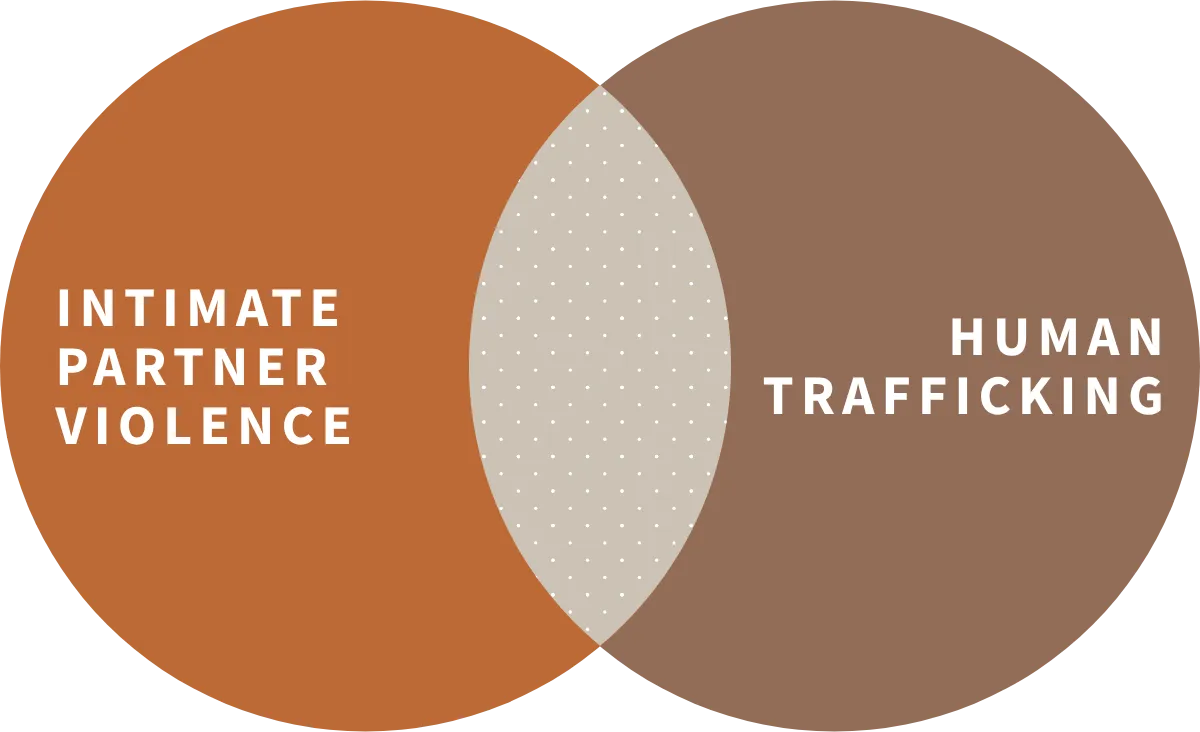
Treating trafficking as IPV, or IPV as trafficking, can obscure what is actually happening and lead to the wrong kinds of responses.
When the two are mixed together, it creates confusion and can repeat a ‘chains and ropes’ misrepresentation, in which trafficking does not look like how it is portrayed.
Blending issues can also shift funding and attention toward an ever-expanding focus on trafficking at the expense of other needed supports for people experiencing different forms of violence.
In 2023, the Canadian Women’s Foundation stated that “[r]esources are diverted from critical programs serving survivors of domestic violence and intimate partner violence, and violence prevention programs…and reallocated through mass investments into anti-trafficking programs focused on disempowering rescue narratives2.”
Do Awareness Campaigns Measure Success Or Impact?
Evaluating an awareness campaign and measuring its impact are crucial to ensuring that prevention goals are met.
Most anti-trafficking awareness campaigns do not collect or share any meaningful measures of their success beyond clicks, likes, reshares, and website traffic—which are digital engagement metrics, not meaningful measures for preventing human trafficking.
This is important because awareness campaigns are monopolizing anti-trafficking funding; funders and donors pour their resources into them while many smaller community organizations doing front-line work and providing evidenced-based responses remain underfunded, undervalued, and misunderstood.
There is often little accountability for whether these investments produce effective outcomes.
Awareness campaigns are well-liked by the general public and make people feel something meaningful is being done to address human trafficking. Questioning their effectiveness is unpopular.
We must be open to new information and ideas to adapt and improve our responses to trafficking—including improving awareness campaigns themselves.

There’s a better way!
By learning what genuinely helps, we can move from superficial awareness to meaningful action that supports victims and reduces exploitation.
Footnotes
1. Millar, H., & O’Doherty, T. (2015). The Palermo Protocol & Canada: The evolution and human rights impacts of antitrafficking laws in Canada, p. 78. https://icclr.org/wp-content/uploads/2019/06/Palermo-Project-Key-Findings-Report-15-October-2015-with-copyright-2.pdf
2. Canadian Women’s Foundation. (2003). Brief for the Standing Committee on the Status of Women (FEWO) for its study on the Human Trafficking of Women, Girls, and Gender Diverse People, p. 4. https://www.ourcommons.ca/Content/Committee/441/FEWO/Brief/BR12395641/br-external/CanadianWomensFoundation-e.pdf